Introduction
For years, earning a degree was considered the key to a successful career. In today’s rapidly evolving world, the job market is changing faster than ever. While degrees have traditionally been seen as the key to career success, employers are increasingly placing greater value on practical skills. With the rise of technology, online learning, and digital careers, individuals can now acquire job-ready skills outside traditional education systems.
This change has led to an increasing discussion over why skills are becoming more important in today’s workplace. Professionals and students who wish to remain competitive in the contemporary workforce must understand this trend.
Why Degree Still Matters
🎓 Credibility
A degree shows that you have completed structured learning and gained foundational knowledge in your field.
📚 Knowledge Base
Degrees help build strong theoretical understanding, which supports better decision-making and problem-solving.
🚪 Career Access
In many industries, a degree can help you qualify for interviews, higher studies, and professional opportunities.
1.Credibility and Recognition
A degree shows that you have completed a structured course of study and possess foundational knowledge in a field.
2. Stronger Knowledge Base
Degrees provide theoretical understanding that helps professionals solve complex problems and adapt to new situations.
3.An Edge over competitors
When two candidates have similar skills, the one with a relevant degree may have an edge.
While skills help you perform a job, a degree helps you access opportunities and build a strong foundation.
Why Skills Are Taking Center Stage
1.Technology Changes Rapidly
New technology, software, and tools are always being developed. Professionals who possess practical skills are able to change more quickly than those who solely rely on academic information.
2.Employers Pay Attention to Performance
Employers are interested in your abilities rather than merely your academic background. It frequently counts more to demonstrate abilities through projects, internships, or portfolios.
3. Growth in Digital Professions
Practical experience is valued more highly than degrees in fields like digital marketing, content development, graphic design, coding, and data analytics.
The Changing Hiring Landscape
| Degree |
Skills |
| Shows academic knowledge |
Shows practical ability |
| Helps access interviews and formal roles |
Helps perform better in real jobs |
| Builds credibility |
Builds job readiness |
| Important for traditional careers |
Important for digital and practical careers |
| Gives a strong foundation |
Helps apply knowledge in real situations |
Degrees are no longer the only factor used in hiring decisions today. Employers are now looking for candidates who can show real skills, practical experience, and problem-solving ability. Companies want people who can adapt quickly, use modern tools, and contribute from the beginning. Portfolios, internships, certifications, freelance work, and projects have become important proof of ability.
This is especially true in fields like digital marketing, coding, design, content creation, data analytics, and social media management. In these careers, what you can do often matters more than just what certificate you have. So skill-based hiring is replacing qualification-based recruiting in the employment market.
Degree v/s Skills : The Real Answer
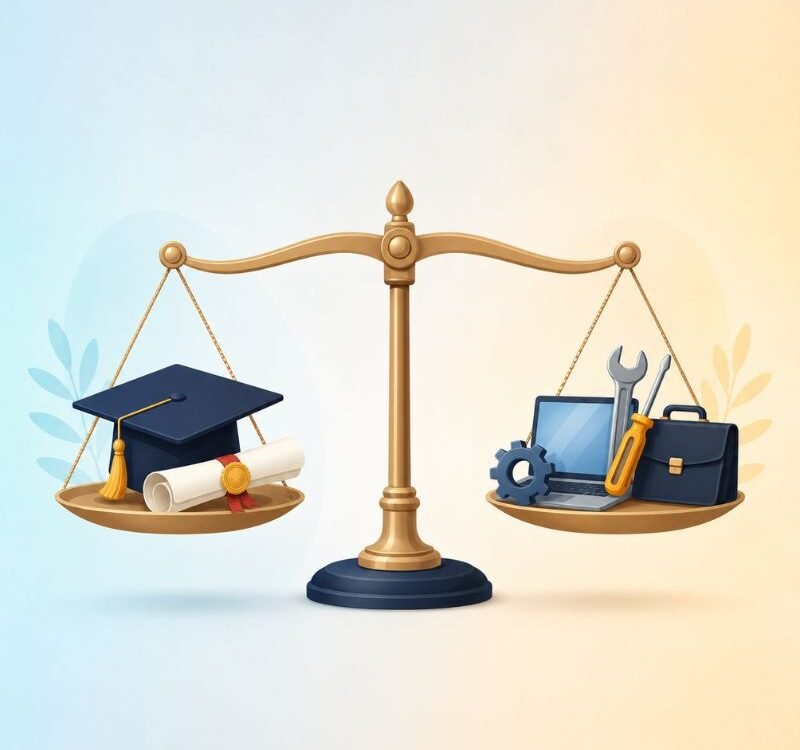
Although the argument between a degree and skills is frequently framed as an either-or choice, the truth is different. Both are important in today’s job market. A degree offers access to job options, a solid academic background, and reputation. Conversely, skills show that you can use your knowledge and function well in practical settings.
Candidates with both qualities are becoming more and more in demand. While a degree could help you secure an interview, your abilities are often what determine whether you are hired and thrive in the position. As a result, the true solution is degree plus skills rather than degree v/s skills. The ideal method to develop a successful profession in the modern world is to combine formal education with real-world experience, certifications, internships, and ongoing education.

Role of Practical Experience
Practical experience plays a crucial role in career development because it helps individuals apply theoretical knowledge to real-world situations. While a degree provides academic understanding, practical experience teaches how to use that knowledge effectively in the workplace. Through internships, part-time jobs, freelance work, and hands-on projects, students gain valuable exposure to industry practices and workplace challenges.
This experience helps develop essential skills such as communication, teamwork, problem-solving, and time management. Employers often prefer candidates with practical experience because they require less training and can adapt more quickly to job responsibilities. It also demonstrates initiative, commitment, and the ability to perform tasks in a professional environment.
Why Employers Prefer Job Ready Candidates
Employers prefer job-ready candidates because they can contribute to the organization from the very beginning.Additionally, job-ready applicants exhibit traits that are highly appreciated in today’s workplace, such as problem-solving, communication, teamwork, and adaptability. They are more adept at overcoming obstacles and achieving corporate objectives because of their capacity to apply information in practical settings.
In a competitive business environment, companies seek employees who can deliver results quickly. As a result, candidates with practical skills, internships, projects, and industry-relevant experience often have an advantage over those who possess only theoretical knowledge.
Importance of Internships and Projects
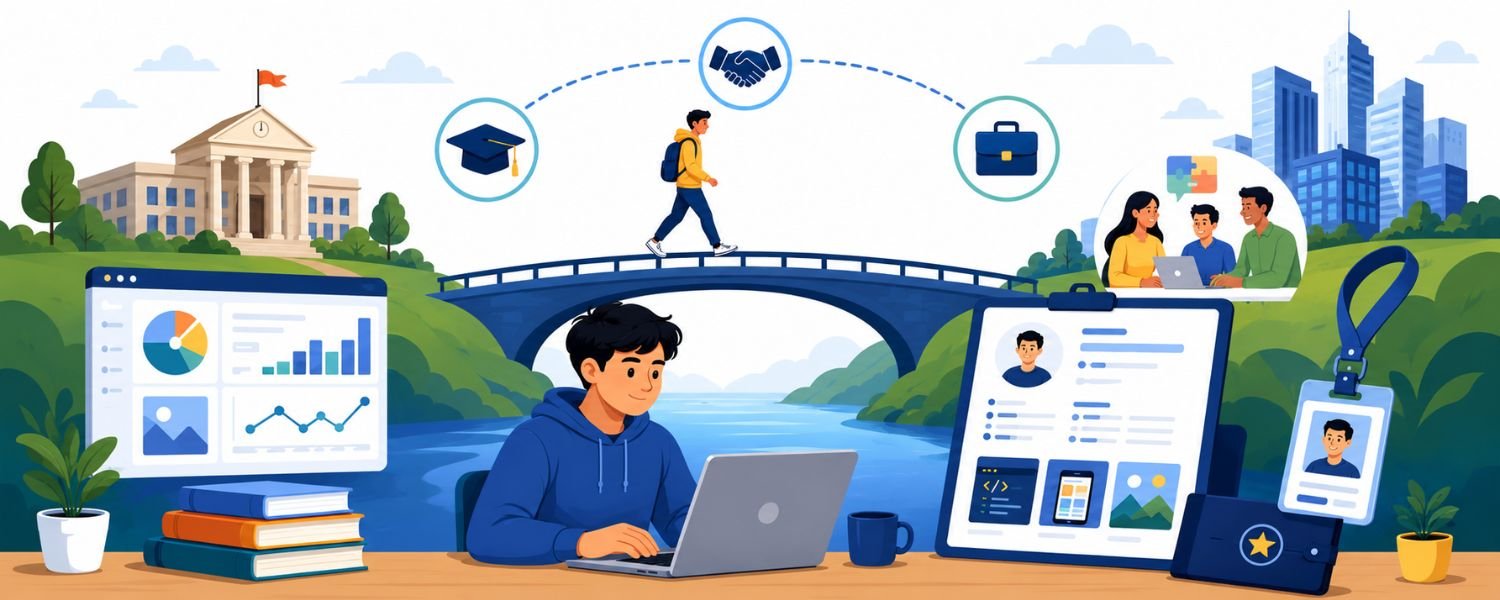
Internships and projects are essential for bridging the gap between theoretical knowledge and practical application. While classroom learning provides a strong foundation, internships and projects allow students to gain real-world experience and understand how industries operate.
Through practical exposure to professional settings, internships assist students in developing workplace competencies like problem-solving, teamwork, communication, and time management.Additionally, they offer chances to gain vital industry connections and learn from seasoned professionals.Because internships and projects demonstrate real skills and job experience, many employers value them.
In a competitive job market, candidates with impressive project portfolios and relevant internship experience frequently stand out.As a result, projects and internships are essential for improving employability, boosting self-esteem, and preparing students for prosperous careers.
How Students can Balance both
By making good use of their college years, students can balance their degree and skills. While skills prepare students for real-world employment, a degree provides academic understanding. In addition to understanding their topics and attending lectures on a regular basis, students should devote time to mastering practical skills like data analysis, digital marketing, coding, design, writing, and communication.
To develop their skills, they can enroll in workshops, online courses, internships, and certification programs.Project work is crucial because it enables students to put what they have learned into practice. Effective time management is essential. It can make a significant impact to dedicate even one hour a day to skill improvement.Students can become more self-assured, prepared for the workforce, and successful in their careers by fusing education with real-world experience.
Conclusion
The debate between degrees and skills is not about choosing one over the other. In today’s competitive job market, both play an important role in shaping a successful career. A degree provides knowledge, credibility, and a strong educational foundation, while skills demonstrate the ability to apply that knowledge in real-world situations.
Employers are seeking applicants who can combine academic credentials with real-world experience as sectors continue to change. Students can become more flexible and prepared for the workforce through internships, projects, certifications, and ongoing education. In the end, professionals who strike a balance between education and skill development are the most successful. Students can expand their career options, remain relevant in a changing workplace, and experience long-term professional progress by investing in both.

.webp)